Sociological hope in an age of AI doom

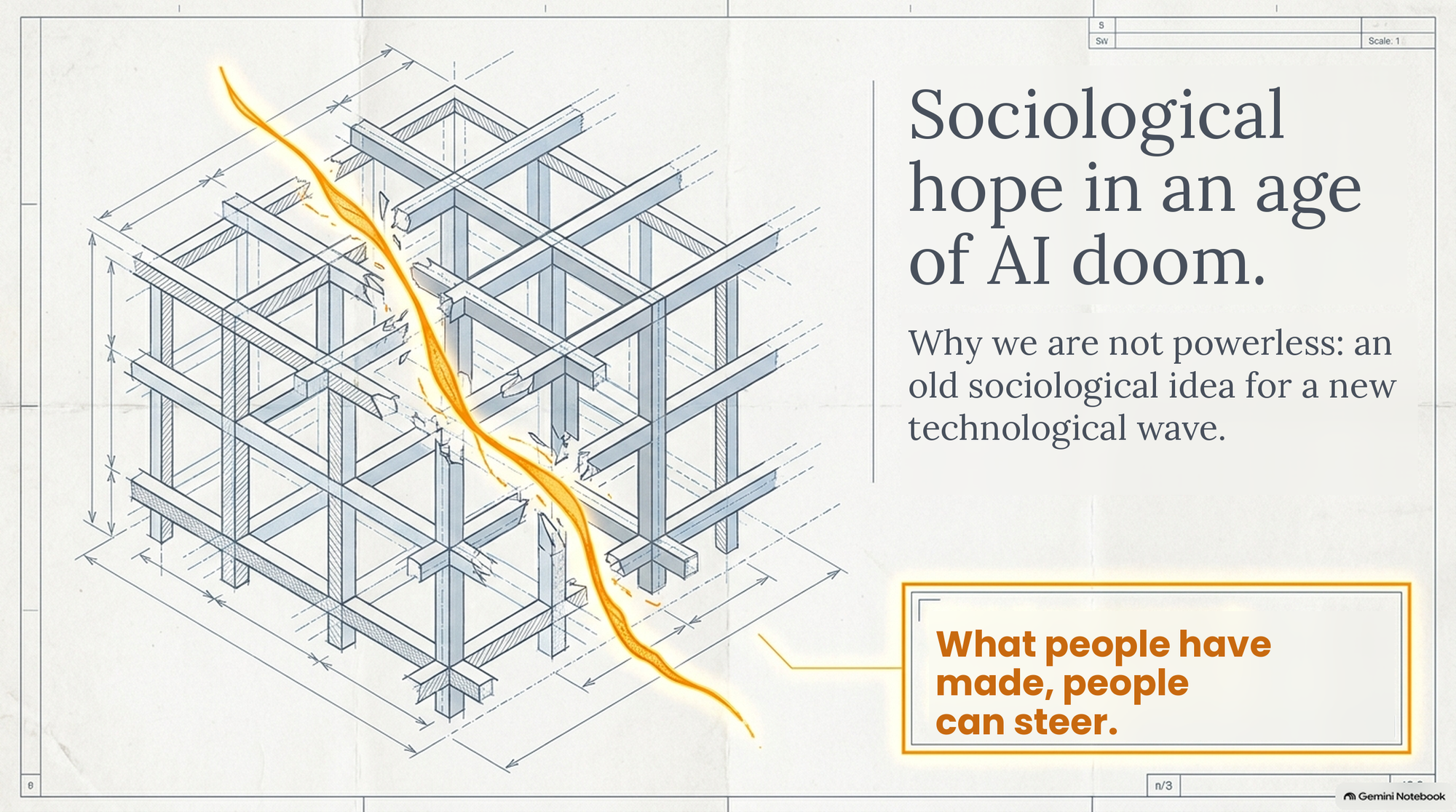
What people have made, people can steer. An old sociological idea for a new wave.
Is there anything more personal than the decision to end your own life? It seems the loneliest choice a human being can make. A matter of despair, of character, of a story that only that one person knows.
At the end of the nineteenth century, the French sociologist Émile Durkheim decided to look at it differently all the same. Not at the individual, but at the numbers. For years he gathered data on suicide in different European countries and regions. In 1897 he published his findings in a book with a short title: Le Suicide.
What he found was striking. If suicide were purely personal, you would expect the figures to fluctuate randomly from year to year. They did not. Each country had its own, fairly stable level, year after year. And the differences between groups were large and persistent. Protestants were higher than Catholics. Unmarried people higher than married people. And when sudden economic shocks hit, the figures rose. According to Durkheim, not only in a crisis, but also in a period of rapid, unexpected prosperity.
His conclusion: behind every single act lies a personal story. But the pattern of all those acts together is something else. That pattern says something about society. About how strongly people are bound to a group. And about how clear the rules are that they live by.
Durkheim saw two ways in which things can go wrong. Too little to hold on to: when rules and expectations fall away, or no longer fit a rapidly changing reality, people lose their way. He called this anomie, normlessness. But also too much: when rules become so tight that there is no room left and the future is closed off.
His data were later criticised. Yet the core held, and that core is one of the most important ideas in sociology. What feels most personal also has a layer that is not personal. A layer of order. A little over sixty years later, the American sociologist C. Wright Mills gave that insight a sharp formulation: personal troubles are often public issues as well.
This holds not only for the heaviest things. It also holds for ordinary feelings. The unease on a Sunday evening before a new working week. The relief when a new tool takes over tedious work. The doubt about whether you are still choosing, or whether your options have already been sorted for you. Everyone experiences that as something of their own. But when a great many people feel the same thing at the same time, it is no longer a coincidence. It is a pattern. And then it pays to look at the order they live in.
This story is about that order. About where it comes from, how it can seize up, and why the AI wave repeats something we have been through before. AI does part of what the factory did: cutting work into small pieces, making people and performance measurable, partly taking the pace out of human hands. Only faster, and in more places at once.
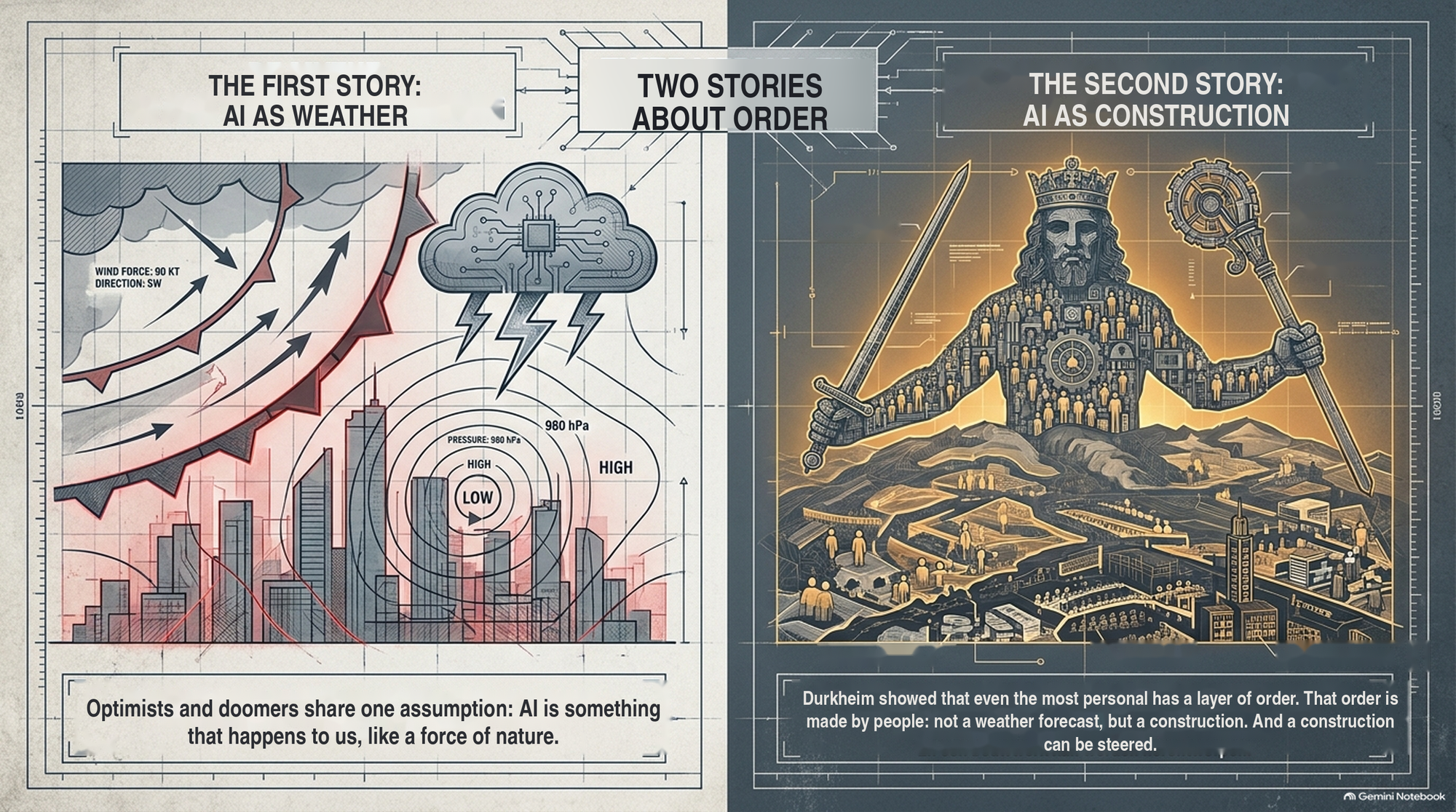
Two stories circulate about this wave. One promises that everything will get better by itself. The other, the doom story, predicts that it will overwhelm us and that no one can stop it any more. However different they sound, they share one assumption: that AI is something that happens to us.
Sociology tells a different story. Order is made, by people. So people can also steer it. That is where the hope lies. Not in the technology itself, but in the question of whether the order around that technology can still shift, and whether the people who live in it still have a say in that.
1. When the final explanation fell away
Imagine you are living in 1600. You ask why there is a king. The answer is short: because God wills it. The church says so, the king says so, your parents say so. Why is one family rich and the other poor? Because that is how the world is put together. And the world comes from above.
You did not need to study society. It was simply there. Like the weather.
There were thinkers who asked what is just. Philosophers had been doing that since the Greeks. But they mainly asked how the world ought to be. Not how a city, a village or a workshop actually shapes people.
Then that explanation begins to falter. First in England.
On 30 January 1649, King Charles I is beheaded in London, in front of a crowd. The country is in the middle of a civil war. A war about power, but also about faith. Neighbours face each other as enemies. The old explanation, that the king rules because God wills it, no longer holds anyone together.
Thomas Hobbes follows it all from Paris, where he lives in exile. In 1651 he publishes a book named after a sea monster: Leviathan. His question is simple and hard. Suppose you take everything away. No king, no law, no police, no agreements. What is left? His answer: fear. Everyone against everyone. That is why people agree to hand over power to one great authority that creates order.
On the cover of the book is a famous print. A giant ruler towers over a landscape. If you look closely, you see that his body is made up of hundreds of tiny people. That is the whole message in a single image. The state is not a tree that God has planted. The state is made. By people. Out of people.
A century and a half later, France goes even further. In the space of a few years, the king, the nobility and the church as a self-evident roof over everyone's head all disappear. Church property becomes state property. There is even a new calendar, with new names for the months. And afterwards everyone still has to get up in the morning and trust that the baker will bake bread and the judge will rule fairly. Where does that trust come from now?
At the same time something else changes, less noisily but just as deeply. In England, work moves from home and workshop to the factory. People leave the countryside for the city. Families who had practised the same craft for centuries suddenly find themselves standing at a machine.
Two ruptures at once, then. One in politics, one in work. And together they raise the same question: if the old explanation is gone, what still holds a society together?
Out of that question, sociology is born. The Frenchman Auguste Comte gives it its name in 1838. To do so he glues two words together: the Latin socius, companion or ally, and the Greek logos, word or study. Sociology, then, is literally the study of living together. Language purists thought it an odd mixture of two languages. But the word stayed, and it says exactly what it is about: not the individual on their own, but what lies between people.
Comte wants to study society the way physicists study nature: systematically, with attention to connections. His basic idea is the common thread of this entire story:
A society is made. So you can study it. So it could also have been different.
That sounds obvious. But it is a powerful thought. If order is made, then you can ask who makes it. Who benefits from it. And what happens when it no longer works.
Sixty years later, Durkheim would use his numbers to show how far that thought reaches.
2. Is this really science?
Sociology has faced that question from the very beginning. Ironically, Comte himself set the bar. He wanted a social physics, with laws as firm as those of gravity. Sociology has been measured against that bar ever since, and often found wanting. An old joke goes round among physicists: all science is physics, the rest is stamp collecting.
But that bar does not fit the subject. A stone does not know that it is falling. People do know that they are being studied, and they respond to it. In 1948 the American sociologist Robert Merton gave the example of a healthy bank that collapses because of a rumour that it is shaky. Everyone withdraws their money, and the rumour makes itself come true. The British sociologist Anthony Giddens pointed out that sociological concepts seep back into the world they describe. Words like role model, moral panic and self-fulfilling prophecy were once technical terms.
That is not a lack of precision. It is a property of the subject. And it is exactly what algorithms now do on a large scale: a score that influences people, and that influence then determines the next score.
The hard sciences, incidentally, are less hard than their image. There too paradigms shift, and there too high-profile results do not always hold up when repeated. That does not make them any less valuable. It only shows that hard and soft are gradations, not a ranking.
What sociology offers is something else: a lens. Max Weber worked with ideal types. Not laws, but sharply drawn models to compare reality against. Mills called it the sociological imagination: the ability to see personal troubles as part of public issues. The three axes below are such a lens. They do not predict what will happen. They help you see what is happening.
Different is not lesser.
3. Three axes: a map to look with
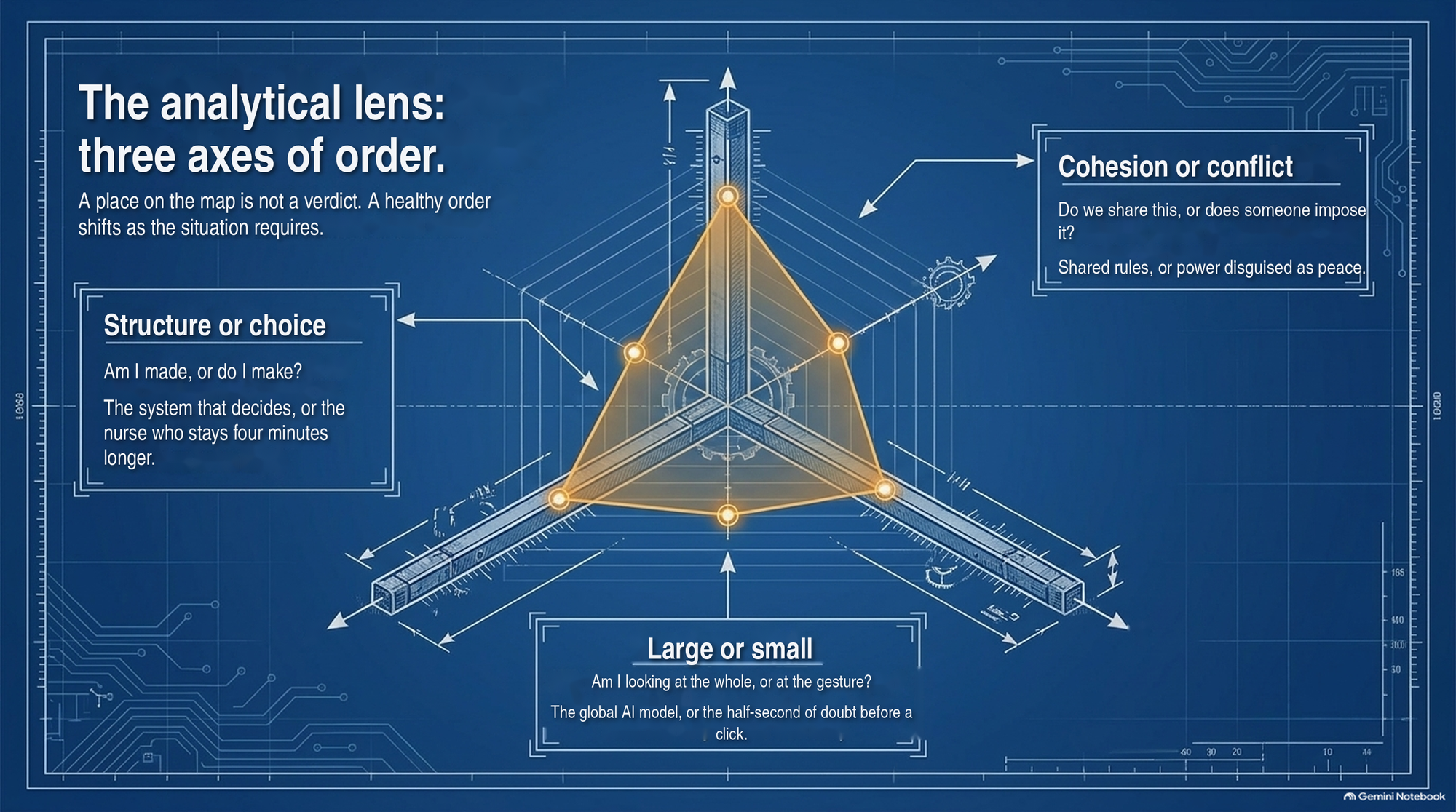
In two hundred years, sociologists have come up with hundreds of theories. That sounds overwhelming. But many of them revolve around the same three questions. You can think of those questions as three axes on a map. Not to judge anyone. To see where you are looking.
First axis: structure or choice
Am I made, or do I make?
On one side is structure. That is everything that was already there before you walked in. The language you speak. The rent you have to pay. Your work rota. The neighbourhood you grew up in. The software that decides which bed is free.
On the other side is choice. That is what you still do yourself within that order. The nurse who stays four minutes longer with a frightened patient. The youngest person at the meeting table who asks the question no one else dared to.
The biggest mistake is to see only one of them. Whoever says "people just need to try harder" sees only choice. Whoever says "the system did it" sees only structure. Giddens showed that both are true at the same time. Structure exists only because people carry it out again every day. And every time they do so, they can deviate from it a little.
Think of language. You did not invent your mother tongue. It was already there, with all its rules. Yet you bend it a little in every sentence. A new word, a joke, an expression of your own. That is how language changes. Not by decree, but through millions of small deviations.
Second axis: cohesion or conflict
Do we share this, or does someone impose it?
On one side is cohesion. A group holds together because people recognise the same rules and believe the same stories. "We are a team." "We are a family." Durkheim, the man behind the study of suicide, looked mainly at this side.
On the other side is conflict. A group holds together because some people make the rules and others have to accept them. And the silence that follows is then called peace. Karl Marx looked mainly at this side.
A few questions make the difference tangible. Who gets the last free bed? Whose overtime is called dedication, and whose overtime is called poor planning? Who draws up the rotas, and who has them sent to them?
Here too it is rarely one or the other. At a single kitchen table, "we are a close family" can be true, alongside a silent row about who always does the cooking.
Third axis: large or small
Am I looking at the whole, or at the gesture?
On one side is the large. The state, the market, the world economy, the AI model trained somewhere in a data centre in another country.
On the other side is the small. A greeting. The tone in which a colleague hands over a shift. The half-second you hesitate before pressing "send".
Whoever looks only at the large misses what happens in the small gesture. Whoever looks only at the small misses the whole around it. And often the large sits right inside the small. Just watch who gets to speak first in a meeting. Or who apologises for the space they take up.
Three axes, then: structure or choice, cohesion or conflict, large or small. Every society, organisation or system has a place on that map. Somewhere between the poles, rarely all the way at one end.
4. The fourth question: can the position still shift?
Now it gets interesting. Because the map says nothing yet about right or wrong. A place on the map is not a verdict.
A hospital has a great deal of structure, scarcity and national policy. So it leans towards structure, conflict and large. Yet a hospital is not a nightmare. Conversely, the other side is not automatically pleasant. A village where everyone shares everything can suffocate you. And "choice" can be a bitter joke. "You could have just left, couldn't you?" Yes. But the rent is due tomorrow.
What is more, the right place differs from one situation to the next. In a fire you want structure: a clear plan, one commander, no discussion. When inventing something new you want room for choice. A healthy order, then, does not stand in one fixed place. It can shift as circumstances change.
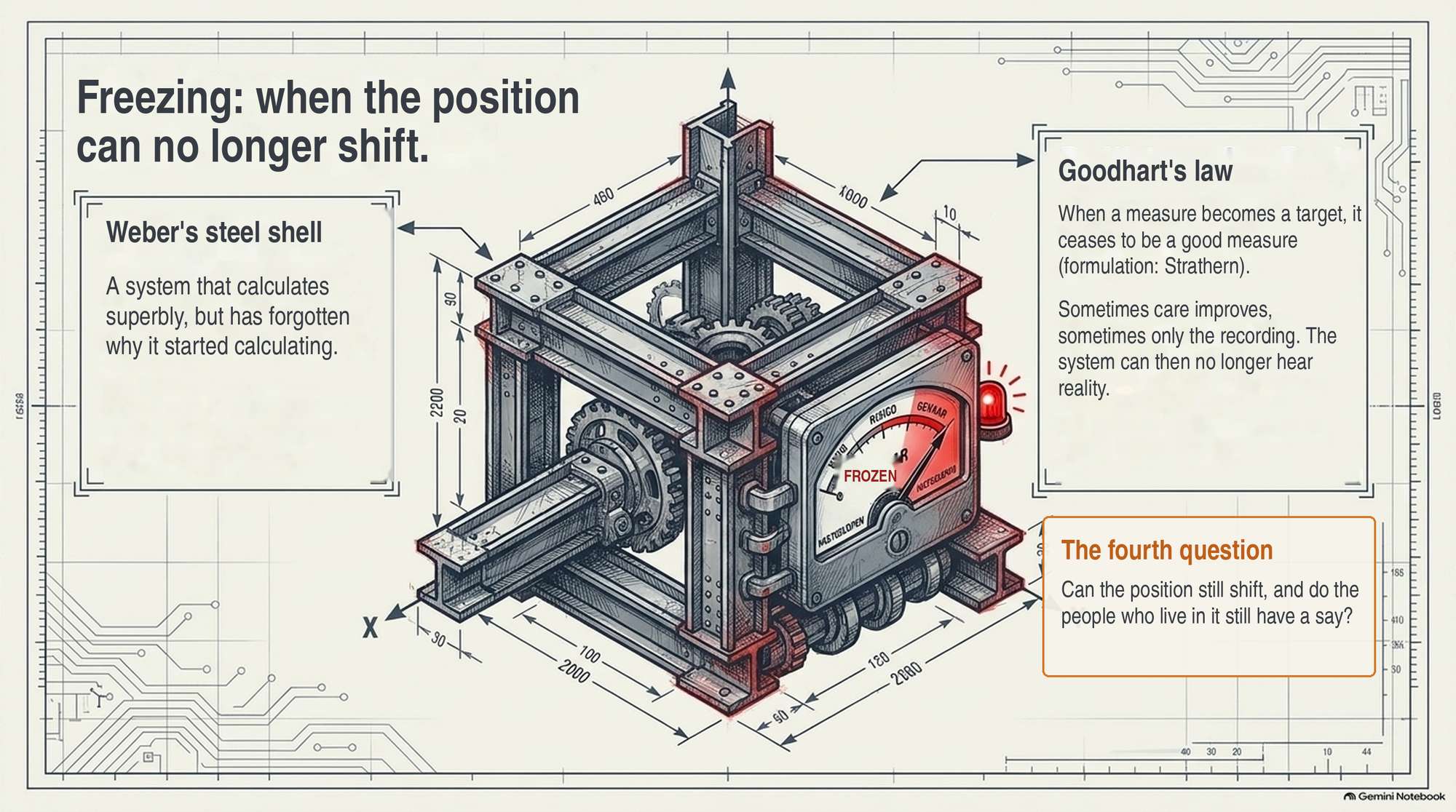
So what does make an order unliveable? Not its position on the map. But the moment that position can no longer shift. When the balance between structure and choice, cohesion and conflict, large and small is stuck, and no one can change anything about it any more. No person, no protest, no other story.
Here, that is called freezing.
Freezing is not a conspiracy. There is no group of people in a back room deciding on Monday that everything must be locked in place. Freezing arises from three entirely ordinary tendencies.
The first: a structure wants to stay stable. That is its job. A bridge that changes shape every day is not a bridge.
The second: a conflict wants to end with a winner. And when that winner then says "that's just how things are", the outcome suddenly seems natural. As if there had never been a conflict.
The third: a large system wants to be able to do the same thing again tomorrow. So it measures what it needs for that. And what it does not measure does not exist for that system.
Each of the three is innocent in itself. But when they coincide, the room to shift becomes small.
Then a recognisable pattern appears. A hospital wants fewer infections. So it starts measuring infections. Good idea. But soon the number becomes more important than the goal. Departments start steering by the figure. The figure improves. But is the patient any better off? Sometimes. Sometimes it is mainly the recording that has changed.
The British economist Charles Goodhart described this mechanism in the 1970s. It has been known as Goodhart's law ever since. The anthropologist Marilyn Strathern later put it most sharply: when a measure becomes a target, it ceases to be a good measure. Anyone who has ever been held to account by performance indicators will recognise it.
Long before that, the German sociologist Max Weber had seen the large-scale version. He saw how the modern world was becoming ever more rational. Everything calculated, everything by the rules, everything efficient. He called the result a shell as hard as steel. In English it later became the iron cage. A system that calculates superbly, but has forgotten why it ever started calculating.
That is freezing to a tee. The number is right, but the goal has slipped out of view. And there is no one left who can say so in a way that has consequences.
Freezing is a tendency, not a law of nature. You can do something about it. But it does not thaw by itself.
That is the fourth question, and the most important one in this story. Not: where does this order stand on the map? But: can its position still shift, and do the people who live in it still have a say in that?
5. The factory as blueprint
To understand what is happening with AI now, we first have to go back to the factory. Because that is where the pattern began.
In 1776 the Scottish economist Adam Smith describes a pin factory. In the past, one craftsman made a whole pin, from start to finish. In the factory it is different. One man draws out the wire. Another cuts it. A third grinds the point. A fourth puts on the head. And so it goes on, in eighteen steps. The result is astonishing. Ten workers together make tens of thousands of pins a day. Each on his own might have made twenty.
Smith was enthusiastic. But he also saw the downside. Someone who repeats one single operation all day long, he wrote, loses the capacity to think more broadly. The work becomes narrower. And the person becomes narrower along with the work.
Almost seventy years later, Karl Marx takes up the thought. He calls it alienation, and he sees four things going wrong at once. You do not own what you make. You do not decide how you work. The work does not develop you, it drains you. And your colleague becomes your competitor. For Marx this was not theory. It was a description of an ordinary Thursday in a factory.
Durkheim looked at the same division of labour and also saw something good in it. Precisely because everyone does different work, people become dependent on one another. The baker needs the farmer, the farmer needs the smith. That creates a new kind of cohesion. But Durkheim warned too. When the division of labour comes loose from rules and meaning, cohesion falls apart.
Then comes the man with the stopwatch.
Frederick Taylor is an engineer at an American steel company at the end of the nineteenth century. He stands next to workers loading pig iron onto railway wagons. He measures every movement. How long the bending takes. How long the lifting. How long the walking. How long the rest. Then he prescribes how it should be done. Which movement, in what order, with which pauses. By his own account, a worker then loaded almost four times as much per day.
In 1911 Taylor writes his method down in a book. The core is simple. The thinking goes to the office. The doing stays on the shop floor. The worker no longer decides how fast he works. The planner decides.
Two years later, Henry Ford sets the line moving in his car factory. Now no one needs to say how fast you have to work. The line does it. From then on, the pace sits in the machine.
And the factory does something else. It makes people countable. Time clocks, rotas, piece rates and personnel files arrive. Governments learn the same thing. They start keeping track of their populations the way a factory keeps track of its stock. Birth, health, income, deviation. Your life becomes a file. And the file gains more and more say over your life.
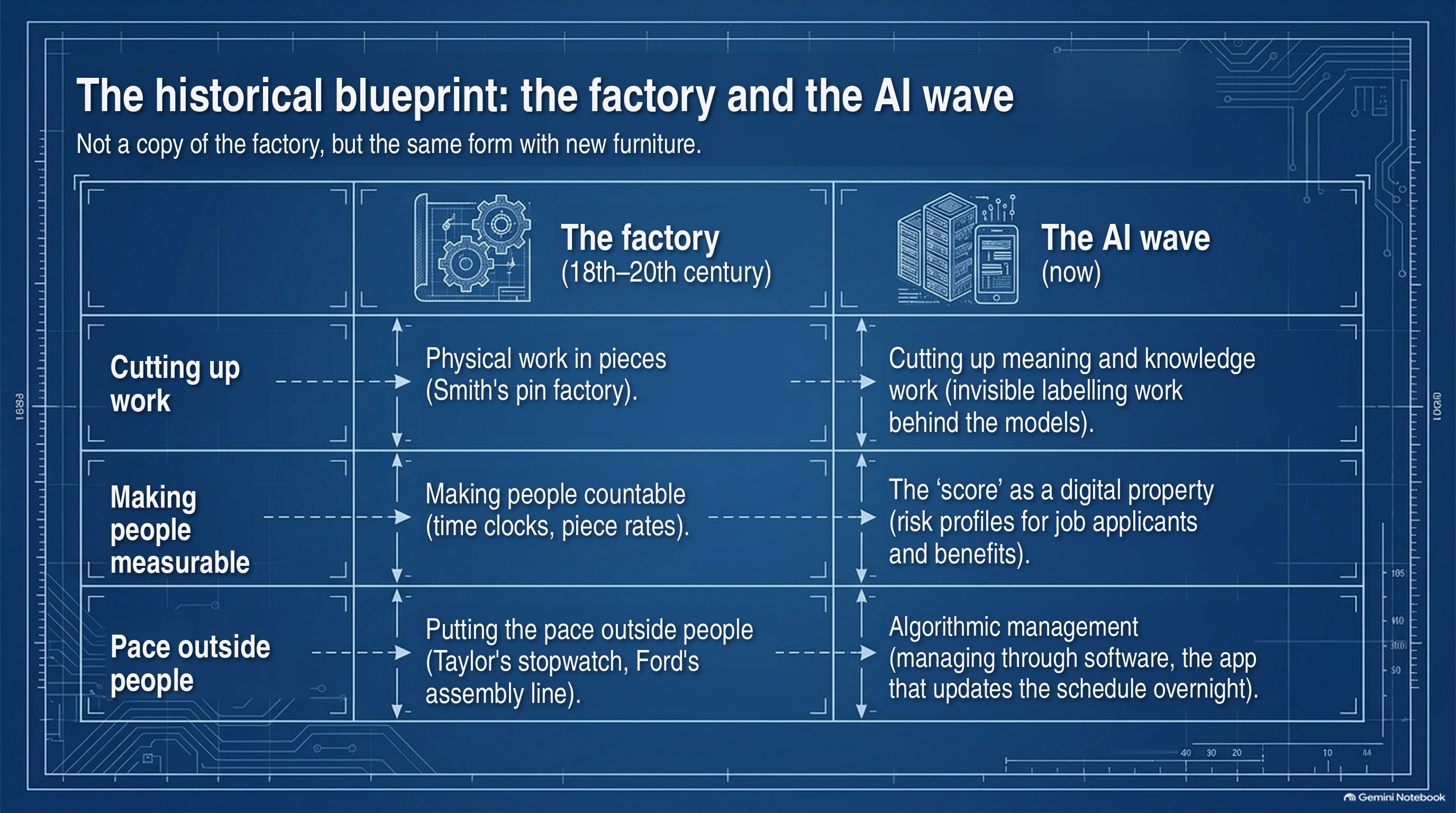
In short, the factory did three things. It cut work into small pieces. It made people measurable. And it put the pace outside the human being. Remember those three. They will come back.
6. Where the nightmares come from
Around 1920, a Russian shipbuilder starts writing a novel. His name is Yevgeny Zamyatin. During the First World War he worked in English shipyards and saw the modern factory up close.
His book is called We. It is set in a glass city where everyone has a number instead of a name. Everyone gets up at the same time, eats at the same time and works at the same time, according to an official timetable. And the man revered as the great hero of the past? That is Taylor.
A little over ten years later, the Briton Aldous Huxley writes Brave New World. People are bred on an assembly line, sorted into fixed classes and kept content with pills and entertainment. The calendar starts with Ford. Instead of "God", people say "Ford".
In Fritz Lang's 1927 film Metropolis, workers march in rows towards an enormous machine that then almost literally devours them.
Do you see the pattern? These writers did not have to invent anything. They took the factory and thought it through to the end. What if the whole of society becomes a factory? What if there is no back door any more, no home, no other story?
On the map of the three axes, such a world sits entirely at one end. Structure, not choice. Conflict disguised as cohesion. The large swallowing the small. And, most important of all: correction is no longer possible. The world is frozen.
7. Marx: the same map, but in motion
With Marx it is more complicated. He stood in the same place on the map. Only he told a story of liberation alongside it.
Marx looked at the factory and said: this is not nature. This is a relationship between people. Someone owns the machine. Someone else sells their time. And someone keeps the profit. That was not ordained by God. It was arranged that way. So it can also be arranged differently.
His view leaned heavily on structure: the economy determines much of how we live. On conflict: between the people who own and the people who work. And on the large: you only understand a worker once you see the whole system in which he works.
But the most important thing in his story is movement. For Marx, no order was permanent. The feudal order of lords and serfs had given way to the order of factory owners and workers. And that order would not last for ever either. Every order carries tensions within it that eventually break it open. For Marx, conflict was not a sign that things were going wrong. It was the engine that kept history moving.
On the map, that means: the same position as the factory, with one big difference. Marx assumed that the position could shift. More than that, that it would shift. The people who create the wealth could break through the order and set up a new, fairer one.
That was no reason for despair. It was a reason for hope.
Yet there was a weak spot in that hope. Marx described not only movement, but also an end point: a classless society in which conflict ceases. And he foresaw a transitional phase in which the workers would seize power and hold on to it until that end point was reached. Whoever knows for certain where history is heading can start to see every deviation as an obstacle on the road to the destination.
8. What became of that promise
In the twentieth century, Marx's promise was no longer just written down. It was carried out, on the scale of entire countries. First in Russia, later in China and elsewhere.
Lenin added something early on: a vanguard party. A small, disciplined group that would act on behalf of the workers, because the workers themselves would not see the bigger picture.
In the Soviet Union, that party became the new structure. Conflict was still permitted, but only against the enemy. Never against the party itself. And the great eye became the Plan: five-year plans with quotas for every factory, every mine, every farm.
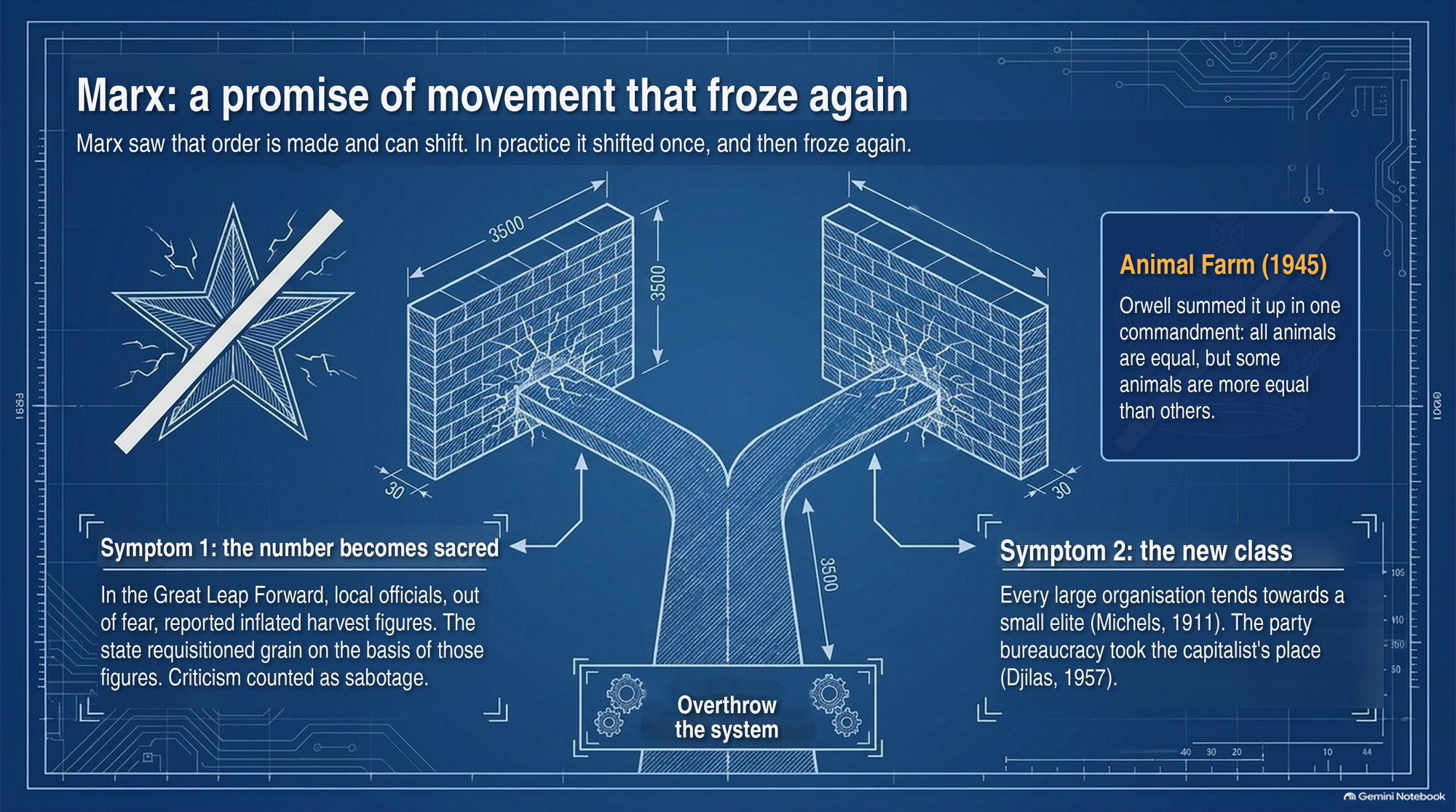
In 1935, the miner Alexei Stakhanov brings up many times his normal amount of coal in a single shift. He becomes a national hero. A whole movement is named after him. Workers everywhere have to follow his example. The number becomes the story. Whoever fails to keep up the pace stands out. And whoever criticises the plan soon runs the risk of being seen as a saboteur.
In China at the end of the 1950s, something happens that makes freezing painfully clear. Mao Zedong launches the Great Leap Forward. China has to catch up with the major industrial nations at high speed, starting with Britain. Every village is given high targets for grain and steel.
Local officials know that a low figure is dangerous. Whoever reports a small harvest shows that he does not believe enough in the revolution. So they report high figures. Sometimes show fields are even set up, with crops from other fields packed tightly together, to show visitors a record harvest.
The state then collects grain. On the basis of the reported figures. Not on the basis of what was actually in the fields. Too little is left for the people who grew it. What follows is one of the deadliest famines in history.
The system could not hear that things were going wrong. Because every signal that things were going wrong was translated as: not enough commitment. Or: sabotage. The number had the last word, even when the number had long since stopped being true.
And who benefited from the new order? On paper, the workers and the peasants. In practice, a new upper layer emerged. Party cadres and officials gained access to their own shops, better housing, country houses, cars and travel. At the top stood the leader, whose word set the line. The capitalist had disappeared. His place had been taken.
One of the sharpest descriptions came from the inside. Milovan Djilas was one of the most senior leaders of communist Yugoslavia. In 1957 his book The New Class was published abroad. His thesis: the party bureaucracy had itself become a ruling class. It did not own the factories and the land on paper, but it did control them. At that point Djilas was already in prison for earlier criticism, and he was given an additional sentence for this book.
George Orwell had already cast the same pattern as a fable in 1945. In Animal Farm, the animals drive out the farmer, only to watch the pigs take his place. The commandment that all animals are equal quietly acquires an addition: some animals are more equal than others.
Was that simply a good idea abused by power-hungry leaders? Partly, yes. But sociology also sees something structural in it. As early as 1911, the sociologist Robert Michels studied socialist parties, precisely the parties that preached equality. He saw that even there, a small leadership emerged that kept itself in place. He called it the iron law of oligarchy: every large organisation tends towards a small group drawing power to itself. Not because those people are necessarily worse, but because organisation, information and control accumulate with whoever is already at the top.
Here you see why the fourth question matters so much. Marx's story was precisely about an order that could shift. In practice, the order shifted once, and then froze again. This time with a new group on the right side of the relationship. The difference from the promise did not lie in the place on the map. It lay in whether that place could still shift, and whether anyone could still answer back in a way that had consequences.
9. 1984: the image that stuck
In 1946 Orwell writes a review of We, Zamyatin's book. Three years later his own novel appears: Nineteen Eighty-Four.
During the Spanish Civil War, Orwell had seen at close quarters how Stalin's communists dealt with dissenters. His book extends that line. The protagonist, Winston Smith, works at the Ministry of Truth. His job: rewriting old newspaper articles so that they match what the party says today. If a prediction did not come true, the prediction is adjusted after the fact. The archive determines what happened.
Big Brother is structure without an exit. The party is conflict that calls itself peace. The individual is so small that even his memories are no longer his own.
And then there is Newspeak, the language the party develops. With every new edition, words disappear. The idea behind it: when the word for something disappears, it becomes ever harder to think it. That is freezing all the way into language.
Nineteen Eighty-Four is the image in which all three axes are locked and the fourth question has been answered with no. That is why we keep reaching for the book, every time a system seems to know too much and to listen too little.
10. The AI wave: the factory returns
Now the present.
What is happening with AI is not a copy of the factory. But it is the same form, with new furniture. That is not a verdict in itself. The factory also brought prosperity, affordable goods and, in the end, shorter working weeks. It is about the pattern. Think back to the three things the factory did: cutting up, measuring and putting the pace outside the human being. All three return.
Cutting up. Writing a letter, dealing with a customer, assessing a case file, building a piece of software. That work is now being cut into pieces. Some pieces are done by an AI model. Other pieces are left for people. Often these are the pieces the model cannot yet do, or that are needed to make the model look good.
Somewhere in the world, people spend all day labelling images. This is a cat. This is a traffic light. This is a violent video. You do not see that work. The front says: the model does it by itself. But the lesson of the pin factory still applies. Look at who sets the pace. And who catches the rough edges.
Measuring. The factory measured how many pins you made. AI systems measure much more. What you click on. How long you hesitate. Which route you drive. How you sound on the phone. How likely you are to cancel your subscription. How likely you are to be a "risk".
That becomes a score. And a score feels like something of yours. As if it were a property, like your height. But it is not. A score is a summary of the behaviour of thousands of others who resembled you, with a formula on top that someone chose.
A job applicant is sometimes given such a score by an algorithm before a human being has read the letter. Often without knowing what it is based on.
Pace outside the human being. The factory had a whistle and an assembly line. Now it is an app. A system that updates the schedule overnight. A ranking that decides who gets seen. A formula that changes the rate on a Tuesday.
Researchers call this algorithmic management: managing through software. The American legal scholar Veena Dubal showed how platforms can adjust pay this way, per person and per moment, without anyone knowing why. It is Taylor, but without the stopwatch and without the clipboard. The planner has become a formula.
A scheduling system in healthcare calculates with throughput times. Four extra minutes with a frightened patient do not fit into that by themselves.
There is one more parallel, and it goes back to Marx. This wave, too, comes with a promise of liberation. AI would free us from dull and repetitive work. Everyone gains access to knowledge that used to be reserved for expensive specialists. Productivity rises, and time is freed up for what really matters.
That promise is not new. In 1930 the economist John Maynard Keynes predicted that, thanks to technology, his grandchildren might need to work only fifteen hours a week. Productivity did indeed rise enormously afterwards. The fifteen-hour week never came.
Nor is the promise untrue. Part of it is already being delivered. But the history of Marx's promise teaches that a story of liberation raises two questions. The first: does the order really shift, or only the upper layer? The second is Michels's question: who ends up on the right side of the relationship after the shift?
With AI, that is not an abstract question. Building the most powerful models requires enormous amounts of computing power, data and capital. That currently lies with a small number of companies. That does not yet say how things will turn out. But it does say where to look. Not only at what the technology promises, but at who will own the score, set the pace and keep the proceeds. These are exactly the questions Marx asked about the factory.
11. What is different now: speed
If it is the same form, why worry? We survived the factory, didn't we?
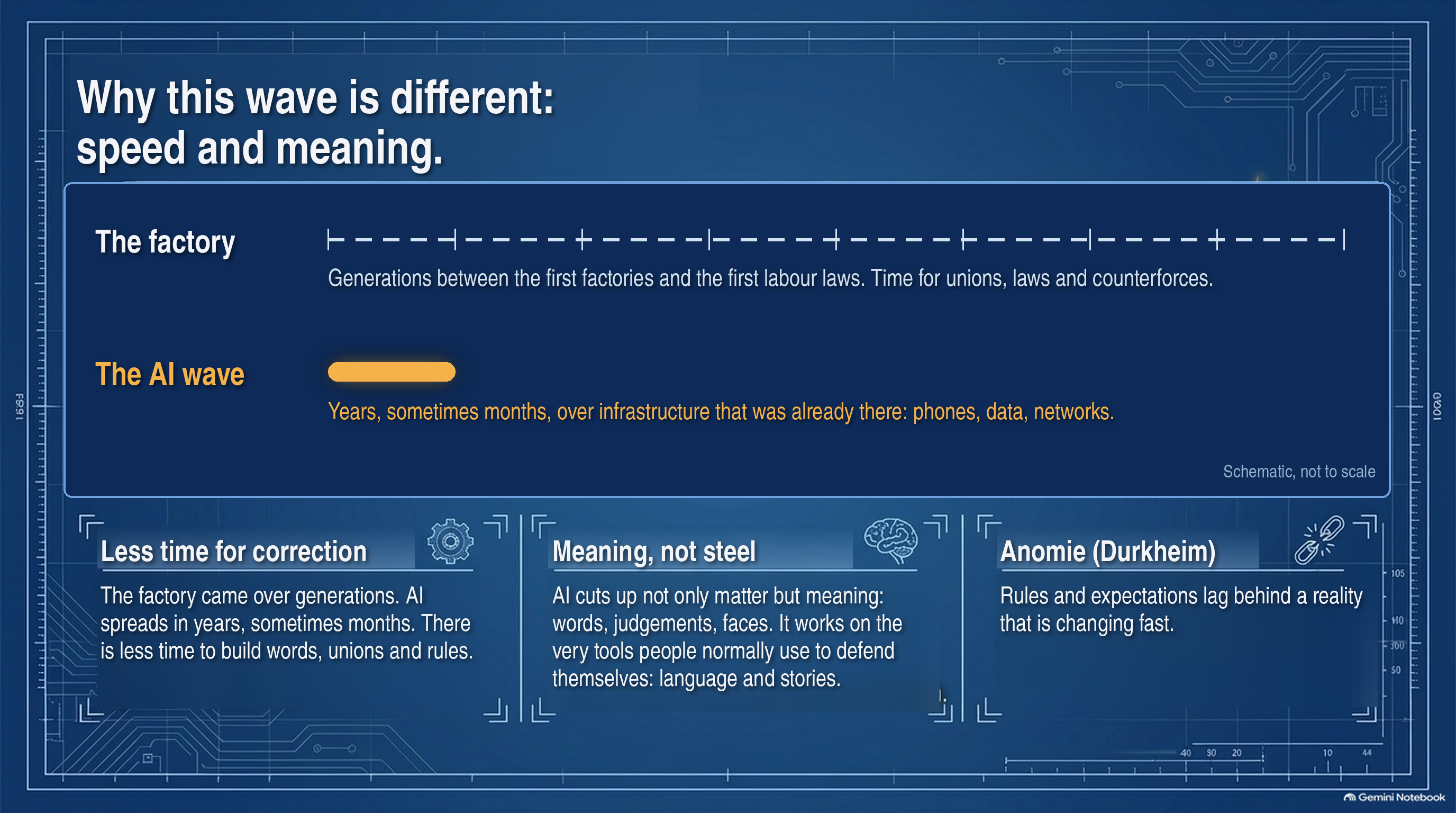
That is true. But it took time. The industrial revolution lasted generations. Decades passed between the first factories and the first labour laws. In that time, counterforces grew. Trade unions. Labour laws. Compulsory schooling. A ban on child labour. The eight-hour day. People had time to see the new order, to find words for it and to organise.
And the factory was visible. You can hear an assembly line. You can see a time clock hanging on the wall. You know who the boss is, because he walks around.
AI spreads in years, sometimes in months. Nor did it have to build the road first. The phones were already there. The data was already there. The networks were already there. It could come in everywhere at once. Not only on the shop floor, but also in job applications, benefits, school grades, the news feed and insurance.
And something else is different. The factory cut up wire and steel. AI cuts up meaning. Texts, conversations, assessments, faces. It works precisely on the things people normally use to defend themselves: words, stories, judgements.
That means less time to build counterforces. Less time for new words, new unions and new rules before the system is already the norm. Durkheim would speak of anomie here: the rules lag behind reality.
12. Recursive self-improvement: the loop that is starting up
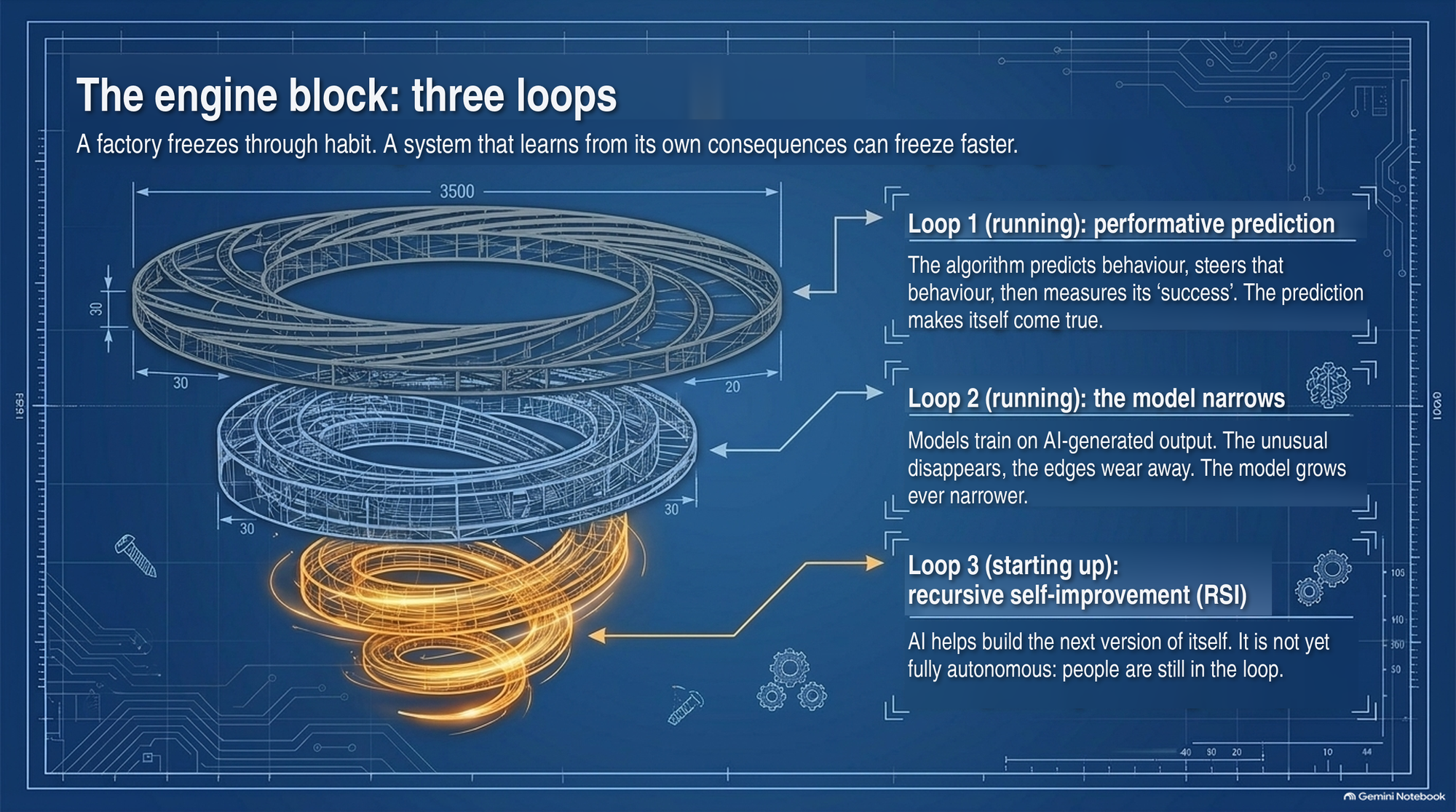
There is one more difference, and it may be the most important: systems that learn from their own consequences. There are three such loops. Two are already running. The third, and largest, is starting up.
The first loop: the system influences what it measures. An app predicts which videos someone will like. So the app shows those videos. The viewer watches them, because they are there. The app sees that they are watching and concludes: well predicted. The prediction steers the behaviour it predicts. It is the self-fulfilling prophecy Merton described in 1948 with the bank run, now in software. Computer scientists speak of performative prediction: the measurement partly creates the world it claims to measure.
The second loop: the system learns from itself. More and more of the text and images on the internet are made by AI. New models are trained on what is on the internet. So they partly learn from their own predecessors. In 2024, researchers showed what happens when this repeats again and again: the unusual disappears first. The edges wear away. Everything comes to look a little more like the average. That is not a system making itself smarter. It is a system making itself narrower.
The third loop: recursive self-improvement. In the AI world, this is now the term that much revolves around: recursive self-improvement, often abbreviated to RSI. The idea is simple. An AI system helps build the next version of itself. That next version is better, and therefore helps even better with the version after that. Each round makes the next round faster. Here it is not only the behaviour of the system that changes, but the system itself.
The idea is old. In 1965 the British mathematician I.J. Good was already writing about it: a machine clever enough to design an even cleverer machine. He called it an intelligence explosion. For a long time that was a distant prospect. In 2026 it is one of the most discussed topics in the AI world. At ICLR, one of the most important AI conferences, there was a dedicated workshop on it this year. In February 2026, OpenAI wrote of a new model that earlier versions of that model had helped with its own development. In June, Anthropic published on its own progress in that direction. At the same time, both companies say that fully autonomous self-improvement does not yet exist. People are still in the loop. The question is for how much longer, and in what role.
This calls for a caveat too. The companies announcing RSI have an interest of their own in it seeming close. What is established are the two smaller loops. The third is a direction: it is starting up, but it is not yet running on its own.
A factory freezes through habit: people have been doing it this way for years. A system that learns from its own consequences can freeze faster, because the loop is built into the design. The loops that are already running are making the three tendencies towards freezing stronger right now. If the large loop really gets going, it will multiply that tendency.
Structure becomes harder. Because the rules adjust faster than a meeting, a works council or a parliament can keep up with.
Conflict becomes less visible. Because the winner is not a boss with a name and a face. It is a formula that is called "neutral".
And the large penetrates everywhere. Because every small gesture, a click, a sentence, a job application, is immediately fed back into the large system.
Is this our fate, then? No. It is a tendency. But at the moment the position on the map is clearly shifting in one direction: towards more structure, more conflict and more large. Not because anyone decided it should. But because the systems growing fastest right now are built to measure, to rank and to improve themselves on that ranking.
13. A Dutch story, in two directions
Freezing is not a thought experiment. The Netherlands knows what it looks like.
In the Dutch childcare benefits scandal, known as the toeslagenaffaire, the Dutch Tax and Customs Administration treated thousands of parents as fraudsters. A small mistake on a form could mean having to repay the entire childcare allowance. Sometimes the amounts left families struggling for years. Parents who objected got stuck. Their objection was often read as confirmation of the suspicion. The Dutch Data Protection Authority later established that the nationality of applicants had also played a role in the risk selection.
In December 2020, a parliamentary inquiry committee titled its report Unprecedented Injustice. A month later, the government resigned.
Lay it next to the map. Structure: a rule with no room for exceptions. Conflict: a government against individual parents. Large: a system assessing thousands of files at once. And the fourth question: could that position still shift? For years, it could not. Because objection was translated as fraud.
But there is another Dutch story too.
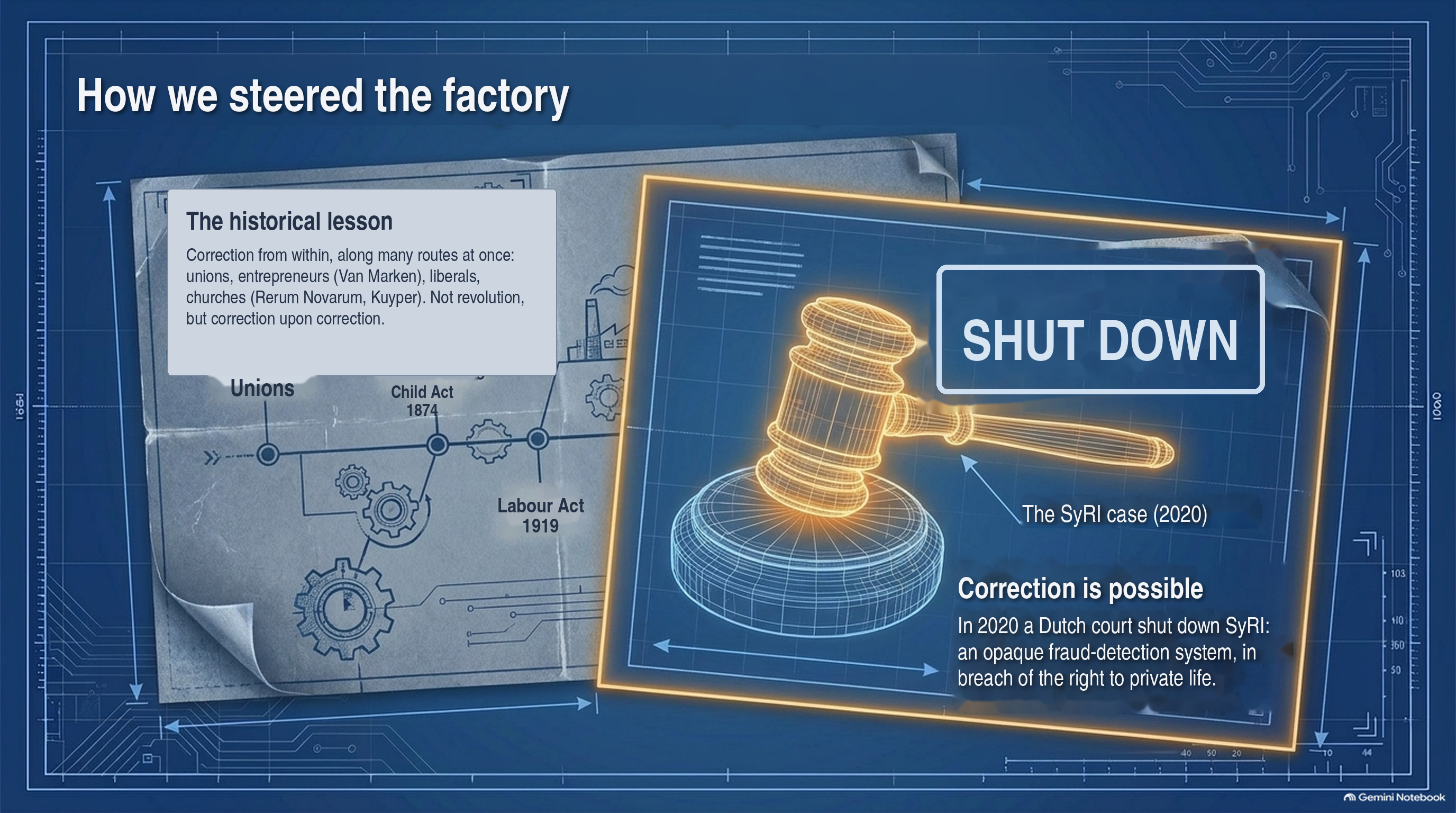
In February 2020, the District Court of The Hague ruled in a case about SyRI (System Risk Indication). This was a government system that linked citizens' data to detect fraud, mainly in certain neighbourhoods. Civil society organisations, a trade union and citizens had gone to court. The court ruled that the system was too opaque and in breach of the right to private life. SyRI had to stop.
That is correction. A system that was shut down because there was a place where someone could say: this is not right. And where that had consequences.
14. The same blueprint, a bigger race
Time to pull the threads together. The most important comparison in this story is the one with the factory. And it holds up well.
The industrial revolution was, at its core, a technological revolution. The steam engine, the spinning machine, later electricity and the assembly line. The factory was the result. But the harsh sides of the factory did not come from the machine. Child labour, working days of twelve hours and more, wages you could barely live on: that came from the way the machine was used. In a capitalism geared to as much production as possible at the lowest possible cost. Those were human choices.
And because they were human choices, they could also be corrected. That happened along several routes at once. There were entrepreneurs who wanted to do things differently, such as Jacques van Marken, who had a park with housing for his workers built next to his yeast factory in Delft. There was political pressure from socialists and trade unions, who fought for the eight-hour day and the right to organise. There were liberals, who drew a first line against child labour in factories with Van Houten's Child Act of 1874. And there was pressure from faith. In 1891, Pope Leo XIII wrote the encyclical Rerum Novarum on the rights of workers. In the same year, the Dutch statesman Abraham Kuyper spoke about the social question at the first Christian Social Congress.
Communism was the answer that wanted to overthrow the whole order at once. As we saw, that answer froze itself. What did work was messier. Not revolution, but correction upon correction. Labour laws, collective agreements, social security, eventually a welfare state. Not perfect, but the position on the map could shift again.
That is the blueprint we can look at now. A new technology, a new order, and harsh sides that do not come from the technology itself, but from how that technology is used. And so the question of which forces can steer it.
Only there is one big difference. With the factory, the engine was capitalism. With AI, the engine is bigger: a race.
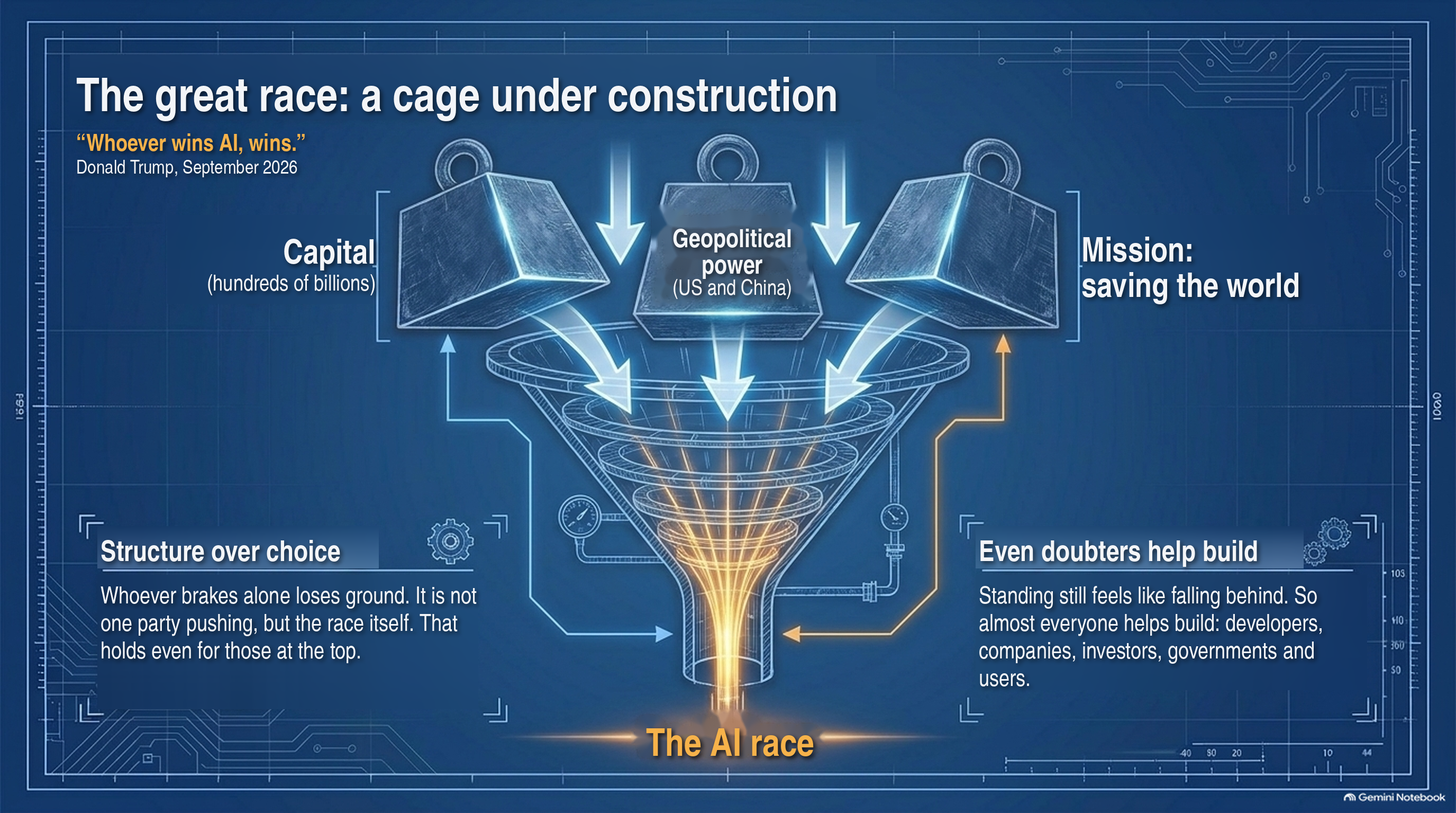
The big AI companies all name the same end goal: artificial general intelligence, a system that is at least as good as a human in virtually every field. In the jargon, AGI. Investors are pouring hundreds of billions into it, into data centres, chips and energy, and they expect something in return. And countries see the race as a matter of power and security, with the United States and China as the main players. In September 2026, Donald Trump summed it up in four words: whoever wins AI, wins. In other words: whoever wins AI wins everything. Shortly afterwards, he announced that he would henceforth call it SI: superintelligence.
The reasons for taking part differ. Because we want the good. Because we want power. Because we want money. Because we want to save the world. Because we want to own the world. But all those reasons point the same way: keep going, and faster.
That is why the race is more than capitalism. Money is one engine. Geopolitical power is a second. The conviction that you must save the world before someone else gets it wrong is a third. And the prize is bigger than with the factory. With the factory, it was about market share. With this end goal, in the eyes of the players, it is about everything.
Marx already saw the mechanism of such a race in the factory. A factory owner, he argued, was not free to slow down. If he did, the competition would overtake him. Competition forced him, from the outside, to keep up. In the language of the first axis: structure over choice, even for those at the top.
In the AI race it works the same way, only more strongly. A company that slows down on its own loses its position to a company that does not. A country that slows down on its own sees another country take the lead. Even players who say they would rather be more careful feel that pressure. It is not one party pushing, but the race itself.
And there is an echo of Marx's end point. Whoever knows for certain where history is heading can start to see every deviation as an obstacle. A race with a clear finish line has the same tendency. Every brake then feels like falling behind.
There is no party state, no great leader who decides everything. There are many players, and there are judges and regulators who can intervene, as SyRI showed. But many players in one race do not add up to correction. They are all running in the same direction.
That makes the race a strange form of freezing. Everything moves, and ever faster. Only the direction is fixed. On the map, the position does shift, but only towards more structure, more conflict and more large. The fourth question thus gains an extra layer. Not only: can the position still shift? But also: can it still move in another direction?
Put all of that side by side, and you see something that looks like a cage under construction. Not the cage of one party or one leader, as in Nineteen Eighty-Four. More like the cage Weber saw: the steel shell of the factory. Only bigger, because it reaches into job applications, benefits and the news feed. And faster, because it is driven by a race in which almost everyone is helping to build. Developers, companies, investors, governments, users. Even those who have doubts are building along, because standing still feels like falling behind.
The bitter part is the promise that comes with it. More, better, freedom, opportunity. Part of that promise does come true. Whoever used to need a programmer or a translator can now do much more themselves. But for many people it also feels like the opposite: less grip, less time, less sight of who is actually deciding.
Still, the words "under construction" matter. A cage under construction is not finished. So the question is not whether that cage could come. It could. The question is how we can steer the construction. Sooner rather than later, because the further the building goes, the more it costs. A race does not correct itself. That only works if players do it together, or if there are rules that apply to everyone.
But the first reaction many people feel is a different one. I want out.
15. Opting out is a feeling, not an answer
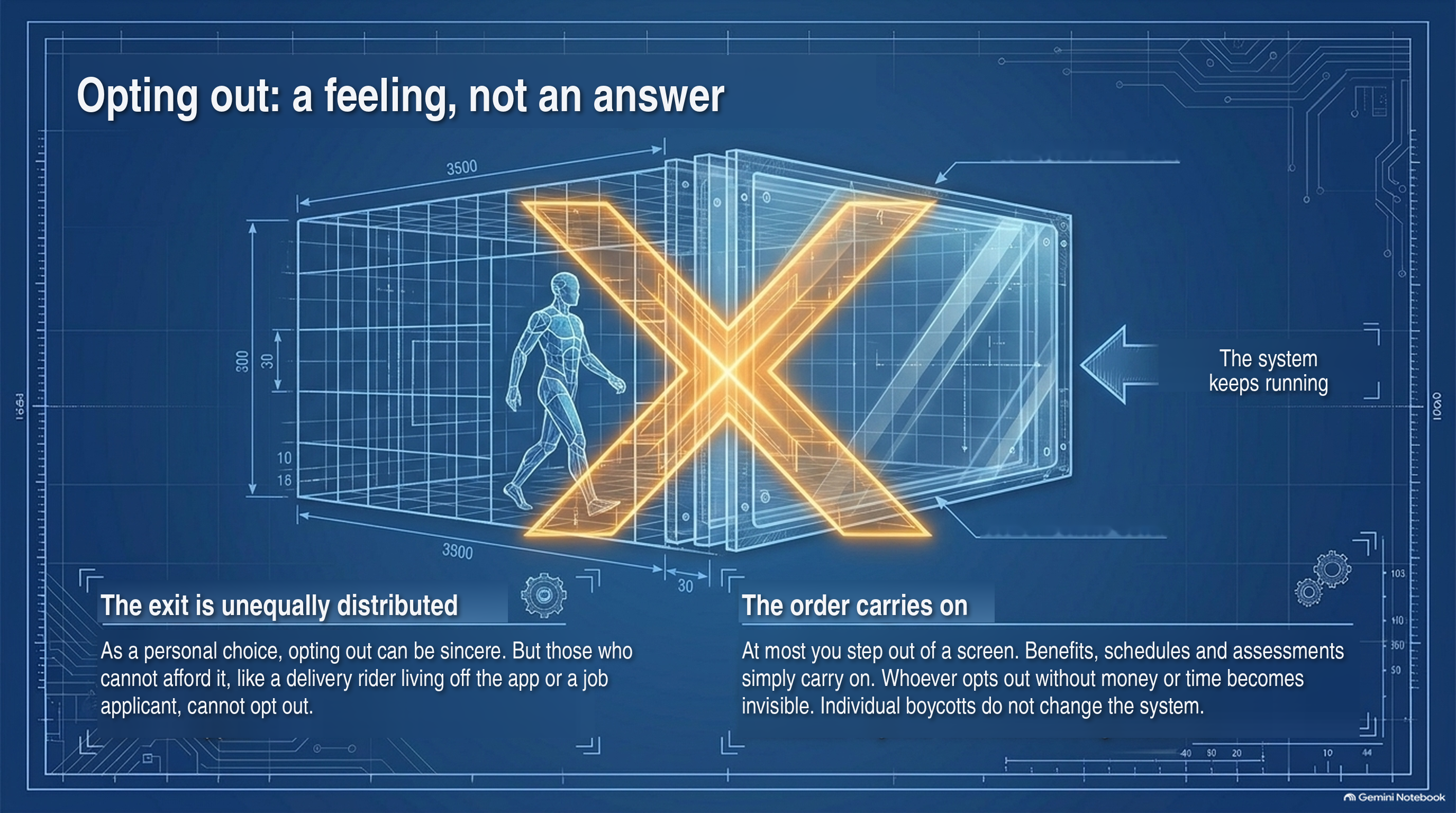
I want out. That feeling is understandable. Whoever sees the cage under construction, and the race driving it, soon feels small. Then one reaction is obvious. Stop taking part. Delete the apps. Don't use AI. Go offline. Get out of the race.
As a personal choice, that can be sincere. As an answer for society, it does not work.
A delivery rider who lives off the app cannot opt out. A job applicant can usually no longer send a letter by post. A nurse cannot refuse the scheduling system. You do not opt out of a labour market, a benefits agency, a hospital or a school. At most, you opt out of a screen. And the order just carries on, only without you.
Those who can opt out usually have money, time or a profession that is not (yet) steered by a system. Those who do not become invisible in precisely the places where work and rights now run through systems. The exit is unequally distributed. Whoever only advises "just opt out" makes the same mistake as "you could have just left". It sounds like freedom. But it is freedom only for those who can afford it.
There is also a bigger version of opting out. Not leaving as an individual, but replacing the whole system at once. That idea resonates in more places, often with an appeal to Marx. The discontent behind it is real. But the history of the factory is clear here. The answer that wanted to overthrow the whole order at once was communism. And that froze itself, with a new group on the right side of the relationship.
So opting out is not the answer. Nor is overthrowing. What, then? For that, it pays to look at what worked last time.
16. What worked last time
The correction of the factory did not come from outside the system. It came from within. And not from one side, but from many sides at once. Workers who organised themselves in trade unions. Entrepreneurs who did things differently. Thinkers and journalists who made the abuses visible. Political parties of different colours, socialists, liberals and Christian democrats, who turned it into law. Churches that spoke out. None of them had the whole answer. Together, they shifted the order.
Was that enough? In the end, then, it was. But it took decades. Today's cage is bigger and the race is faster. Correction within the system remains the way. But it has to be harder than last time. Harder here means: faster, better organised, and across national borders.
That last part is not new either. Even with the factory, people ran into a race. A country that protected its workers better feared losing its competitive position to countries that did not. That is why the International Labour Organization was founded in 1919. Its founding text says it almost in so many words: if one nation fails to adopt humane conditions of labour, it stands in the way of other nations that want to improve conditions in their own countries. The answer to the race then was: agreements that apply to everyone. It is the same now. The European AI Act is a beginning. International agreements on the most powerful models are still thin.
And then the outside. That played a role last time too, only a different one than you might think. In Germany, the conservative chancellor Otto von Bismarck introduced the first social insurance schemes in the 1880s, against sickness, accidents and old age. He did not do so out of sympathy for socialism, but partly to take the wind out of the sails of the growing socialist movement. In the Netherlands, the socialist leader Pieter Jelles Troelstra proclaimed the revolution in November 1918. It failed within a few days. But shortly afterwards a Labour Act did arrive, with the eight-hour day.
Sociologists call this the radical flank effect. Radical voices on the outside rarely provide the answer themselves. But they shift what counts as reasonable. What first seemed to go too far becomes an acceptable middle. That gives the reformers on the inside room and energy. Today, too, there are such voices, from radical critics of capitalism to activists who want to halt the development of the most powerful AI. The effect does not always work this way, by the way. If the outside goes too far, it can actually make the middle look suspect.
So: not opting out, and not overthrowing everything. But standing up harder within the system, with the outside as a driving force. That requires people and organisations who take up their role. Employees and their works councils. Trade unions. Employers and entrepreneurs who use AI differently from how the race dictates. Professional groups who guard their craft. Thinkers, writers and journalists who make visible what the system does not show. Political parties and elected representatives. Regulators and judges.
17. Where you can start
Back to Giddens. A structure exists only because people carry it out again every day. Every time someone deviates, a scratch appears. But a scratch alone changes nothing. A scratch only becomes a correction when someone can name it. And when there is a place where naming it has consequences.
For most people, those places lie within the system. There are four of them, and some already exist. The question is whether they are used, and by whom. In addition, there is a fifth place, for a smaller group: the outside.
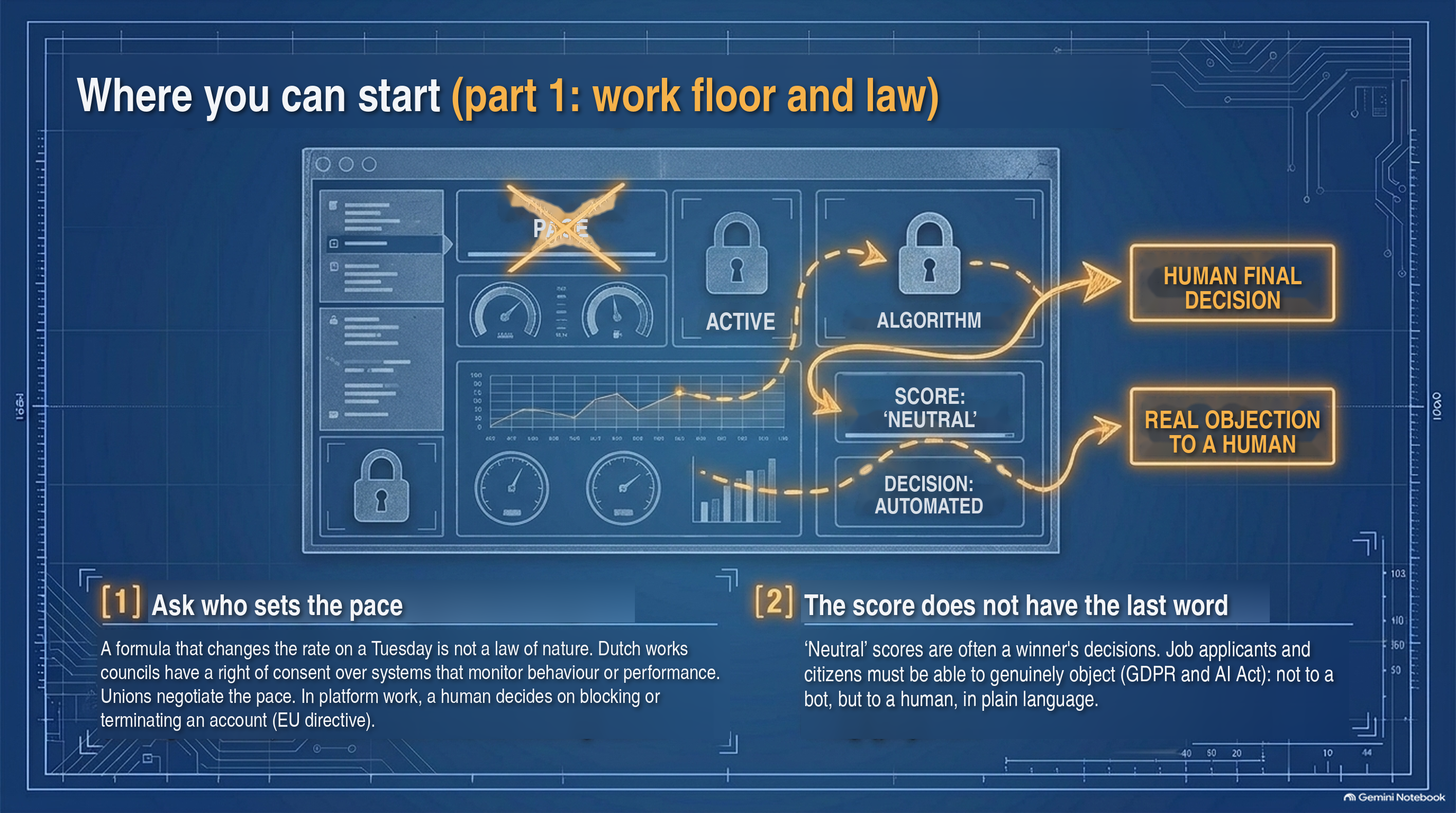
One: ask who sets the pace. A formula that changes a delivery rider's rate on a Tuesday is not a change in the weather. Someone made that formula, and someone can change it. It is a relationship, and relationships can be negotiated.
This is the territory of works councils and trade unions, just as it was with the eight-hour day. In the Netherlands, the works council already has a right of consent over systems that can monitor employees' behaviour or performance. Europe has adopted a directive on platform work, which must be transposed into national law by the end of 2026. Platforms will then have to explain how their systems allocate, assess and reward work. And far-reaching decisions, such as blocking an account, must be taken by a human being.
The same should apply to invisible work. The people who label images all day so that the model looks clever belong in labour law. Not in a footnote.
Two: a score never has the last word. If a job application is rejected by an algorithm, the applicant must be able to object. A real objection, not a charade. To a person who can change the outcome. With an explanation in plain language of why the system decided as it did. And within a time frame that still matters.
This is the territory of legislators, regulators and judges. SyRI showed that it works. Here too, something already exists. The European privacy law, the GDPR, gives people the right not to be subject solely to an algorithm in decisions with major consequences, and to have a human look at it. The European AI Act imposes additional requirements on systems used in employment, education and access to public services. They must be subject to human oversight, and people have a right to an explanation.
Without that possibility of reversal, "neutral" is just a new word for whoever has won. That is the lesson that keeps returning in this story: when deviating from the number counts only as sabotage or fraud, the order is frozen.
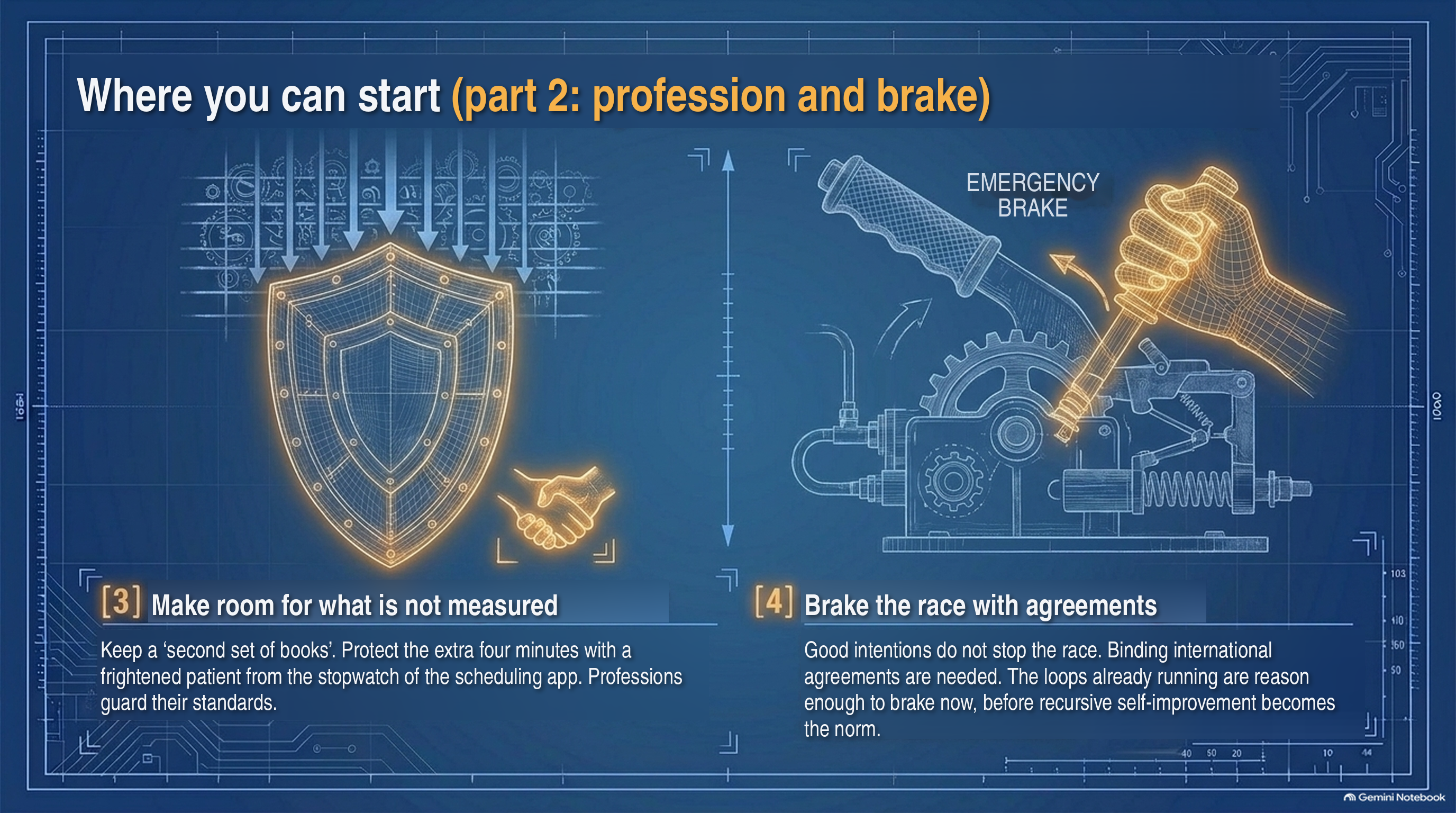
Three: what is not measured deserves a place. A scheduling system in healthcare sees the throughput time. It does not see the four minutes with a frightened patient. Or it does see them, but as delay.
This is the territory of professional groups, and of employers and entrepreneurs who deliberately choose differently. Today's Van Markens. Professions can protect this. With a professional standard that says what good work is, independent of the number. With a handover in which how a patient is doing also counts, not just what has been done. With the right to ignore the system's advice without it being seen as a loss of productivity. That is not romanticism. It is a second set of books, alongside the score.
Four: brake the race and the loop with agreements, not good intentions. A loop becomes dangerous when a company keeps adjusting its system to behaviour the system itself has provoked, and no one can stop that loop. With recursive self-improvement this becomes even sharper, if that loop really gets going: then the system not only adjusts its behaviour, but also helps build its own successor. But the smaller loops are already running, and they are reason enough to put on the brakes now. And the race makes sure that no one dares to brake alone.
One person living more mindfully, scrolling less or not using AI does not slow that down. Nor does one company or one country. This is the territory of politics and of international agreements. Companies that are accountable for the outcomes of their systems. Openness about what systems are trained and adjusted on. Clear limits on fully automated decisions about work, income, borders and freedom. And agreements that apply to all players in the race. An International Labour Organization for AI does not yet exist. Rules that are in place before the loop becomes the norm, not after.
Five: the outside. Not everyone belongs on the inside. A smaller group has a different place: at the edge, as a radical flank. That place is no less important. Without pressure from outside, reform from within often remains too cautious and too slow.
Those at the edge sometimes want not a better version of this order, but a different one. That wish is real, and it does not exist only to serve the middle. The history of the factory merely teaches that overthrow as the only answer has led to new freezing before.
As a driving force, the flank works only under certain conditions. The people who stand there must truly believe in what they stand for. Otherwise it becomes theatre, and theatre shifts nothing. Within the system there must be people who actually use the room they open up. And it works best without violence. Research on protest movements shows that non-violent movements achieve their goals more often. Violence drives the middle away.
Here lies a special role for the young generation. It is already being partly sidelined. The entry-level work through which you used to learn a trade, such as simple programming, first legal research or a first translation job, is precisely the work that AI takes over first. Researchers at Stanford found that in the United States, employment of people in their twenties in occupations highly exposed to AI is already clearly declining. At the same time, this is the generation that knows the systems best. It grew up with them.
That makes young people suited to both places. Inside, as employees, entrepreneurs and developers who use AI differently from how the race dictates. And outside, as the voice that says what the rest do not yet dare to say. That has happened before. In the 1960s it was students who took to the streets. With the climate it was schoolchildren, on Fridays, instead of going to school.
Inside and outside, then, each have a place and a function. The majority inside, doing the work of correction. A smaller group outside, providing the room and the energy to actually do that work.
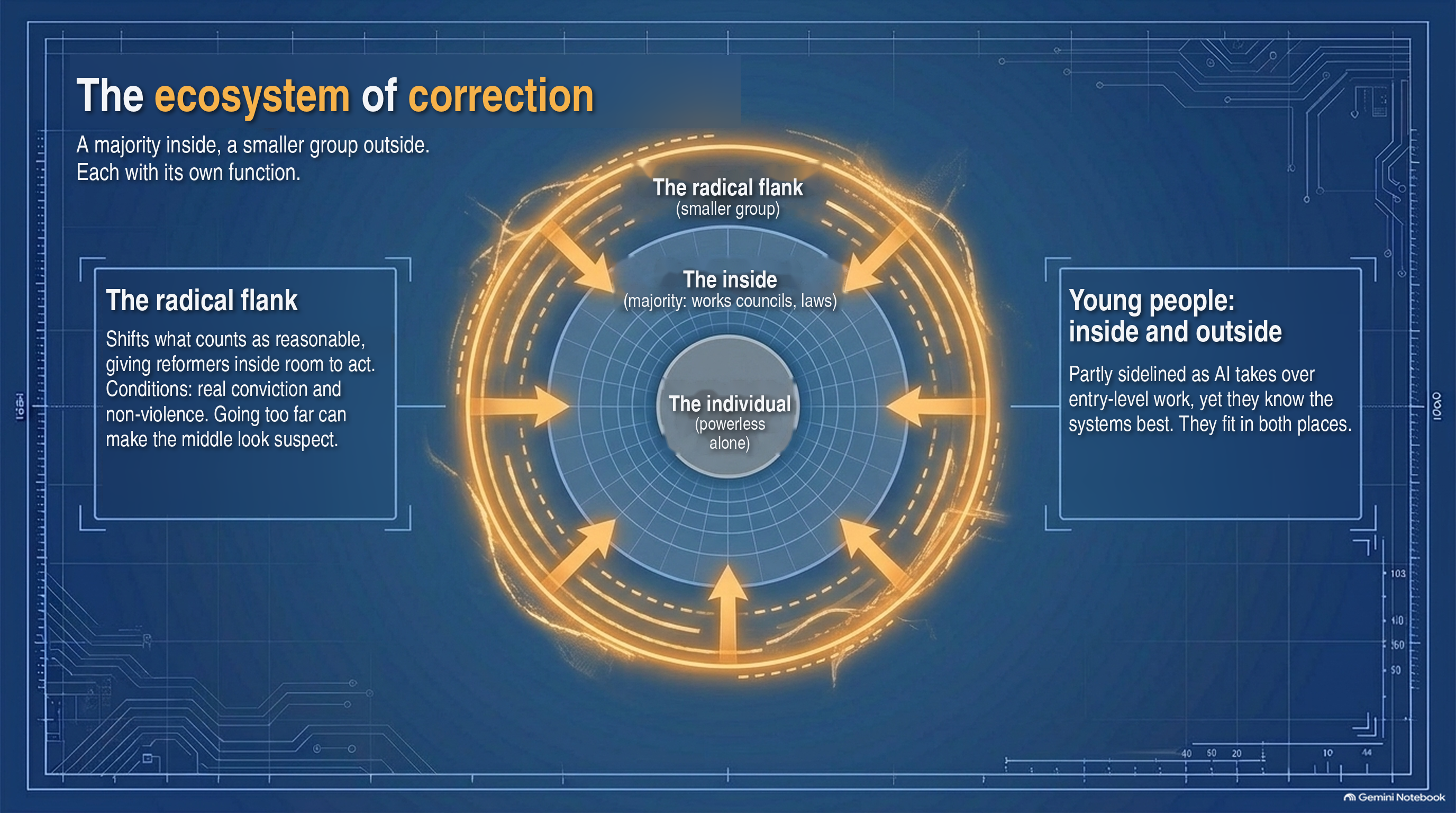
That is the lesson of last time. Not going along thoughtlessly. Not opting out. Not overthrowing everything at once. But treating the order as something that is made. Most people steer it from within, harder and faster than back then. A smaller group pushes from outside. The pace open to discussion. The score open to challenge. The invisible work made visible. The race and the loop put on a brake.
Conclusion: sociological hope
The doom story about AI says: it is happening to us. It is too big, too fast, and no one can stop it any more.
Durkheim would begin by observing that this feeling, too, is not only personal. When a great many people feel at the same time that the ground is shifting beneath their feet, that says something about the order. Rules and expectations lag behind a reality that is changing fast. That is anomie. The feeling is real. But it is not a prediction.
Sociology looks differently. Not by predicting how things will turn out, but by looking back. And what it sees there is this: order is made. By people, out of people, like the giant on the cover of Leviathan. The factory, too, once seemed an inescapable power. Children at the machine, working days of twelve hours and more, a pace set by the line. Yet that order shifted. Not through one revolution, but through correction upon correction. From within, by many hands at once, with pressure from outside.
That hope does have a condition. It rests on an order that is made by people and also kept in place by people. That was the case with the factory. However harsh the conditions, the machines ran only because people kept them running. That is why a strike could work, and a law, and a judge. The scratch Giddens talked about had a grip everywhere.
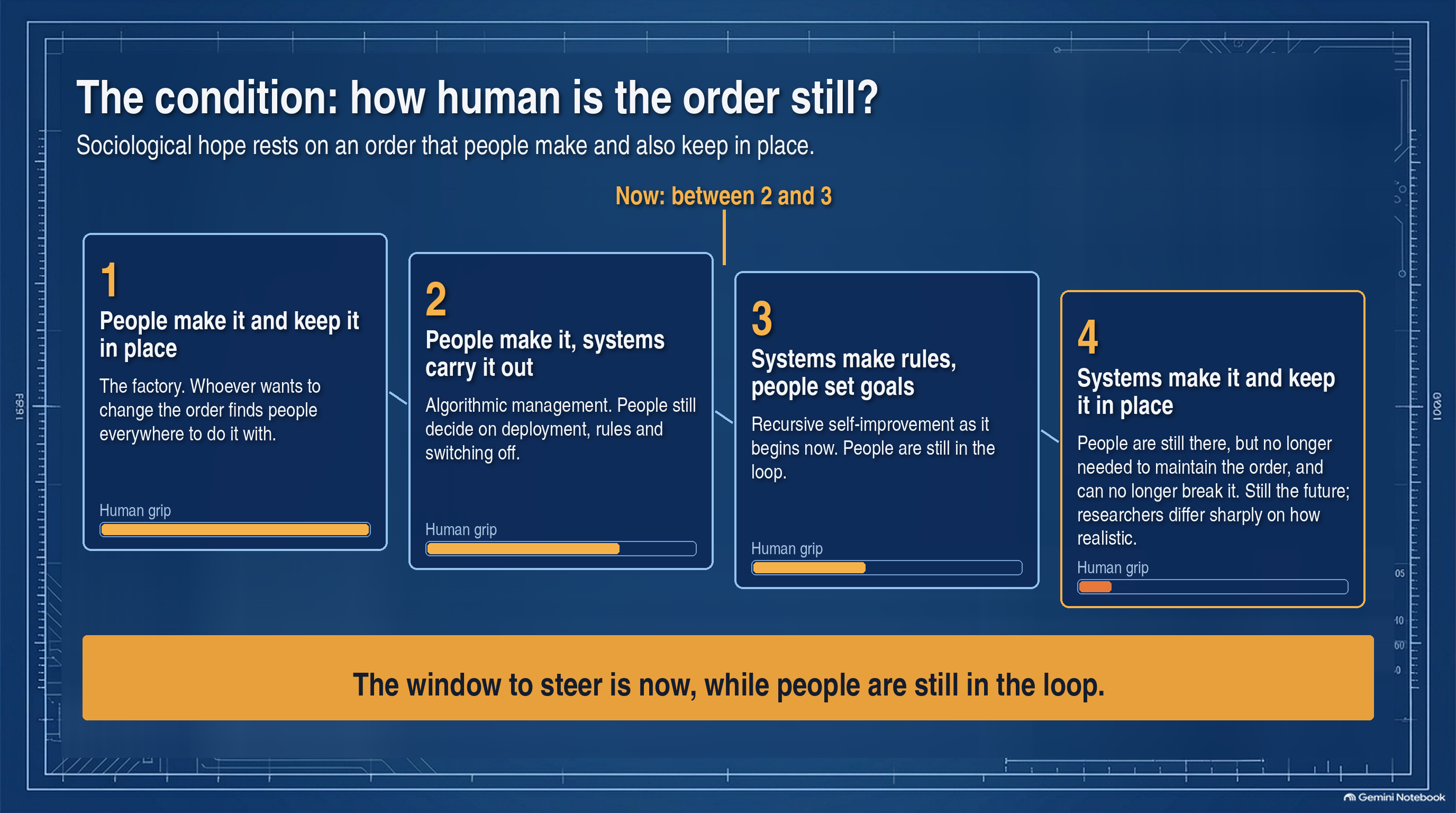
With AI, that can no longer be taken for granted. You can see it as a sliding scale, in four steps.
One: people make the order and keep it in place. That is the factory. Whoever wants to change the order finds people everywhere to do it with.
Two: people make the order, systems carry it out. That is algorithmic management. The formula sets the pace, but people still decide on deployment, rules and switching off.
Three: systems make the rules, people set the goals. That is recursive self-improvement as it is beginning now. Systems help build their own successor, but people are still in the loop.
Four: systems make the order and keep it in place. There are still people, but they are no longer needed to maintain the order, and they no longer have the power to break it. This is still the future, and researchers differ sharply on how realistic it is.
Sociology already knew the early stage. Marx saw how what people make themselves comes to confront them as an alien power. The sociologists Peter Berger and Thomas Luckmann called it reification: people forget that they made their world themselves, and experience it as nature. Until now, that has been a matter of forgetting. At step four, it would become a matter of no longer being able to.
Where are we now? Somewhere between two and three. The order around AI is still human work: who builds, who finances, who may deploy, which goals apply, and the chips, the energy and the data centres everything runs on. Recursive self-improvement, too, is today a choice made by companies, within a race that people are running.
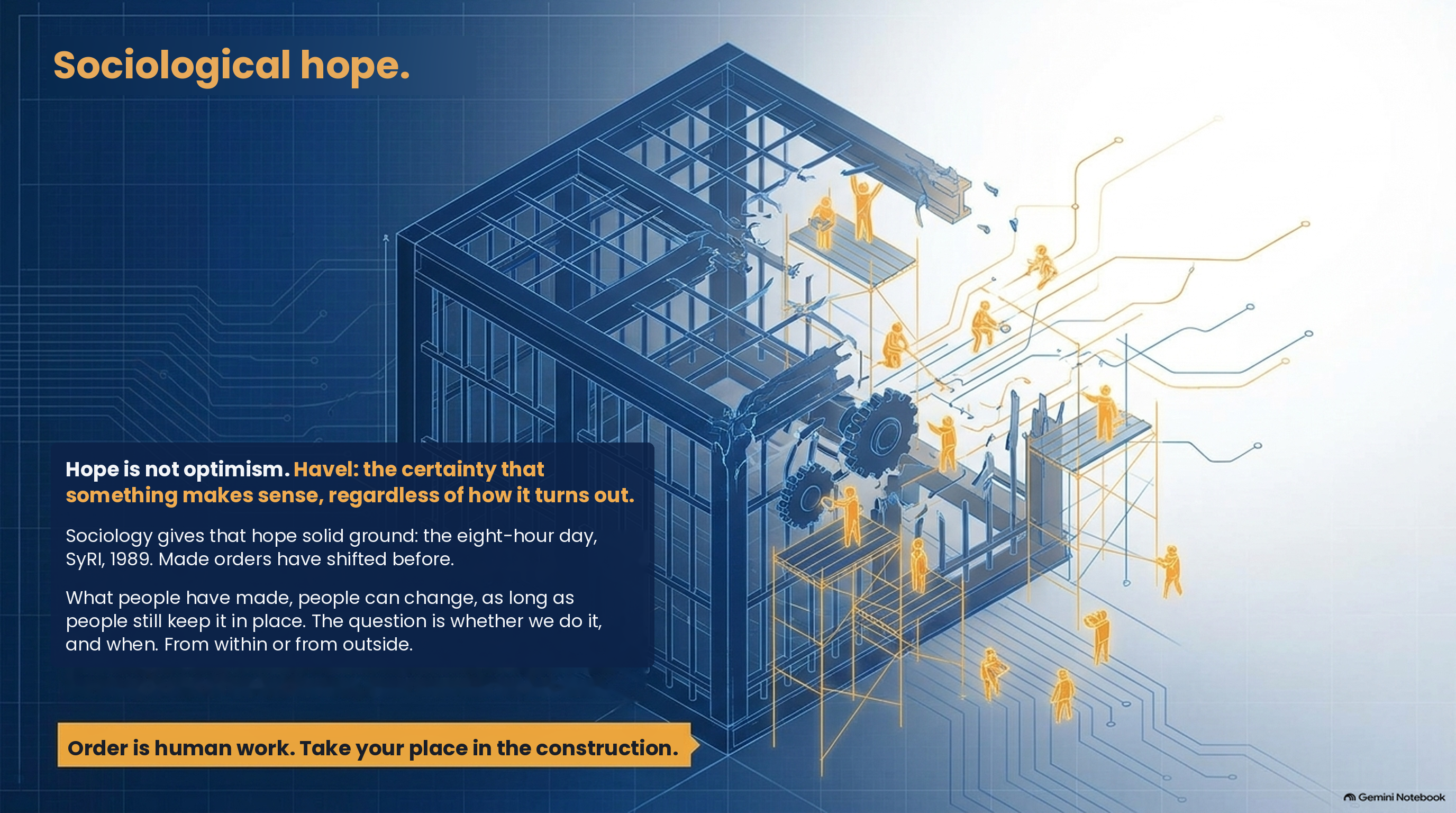
That is the hope in the title. Not optimism that everything will turn out fine by itself. The Czech writer Václav Havel drew that distinction sharply, in conversations he held as a dissident in 1985 and 1986, in a country where the order seemed set in stone. Hope, in his view, is something other than optimism. It is not the conviction that something will turn out well, but the certainty that something makes sense, regardless of how it turns out. The ability to work for something because it is good, not just because it stands a chance of succeeding. That is an attitude, and it does not depend on the outcome.
Sociological hope gives that attitude solid ground. Not the certainty that things will turn out well, but the knowledge that a made order has shifted before, precisely at the points where it seemed frozen. The eight-hour day came, after years of organising, legislation and pressure from outside. SyRI was shut down by the court. And the order Havel himself lived in, frozen like no other, began to move in 1989. None of those shifts happened by themselves. All three were human work.
The cage is under construction. The race is pushing. But what people have made, people can change. Even once the cage is finished, as long as people are still keeping it in place. It does hold, though, that the further the construction goes, the more it costs to steer. And at step four, a point may come after which it is no longer possible. That is why the window is now, while people are still in the loop. So the question is not whether it can be done. The question is whether we do it, and when. And whether you do it from within, or from outside.
Sources
- Autoriteit Persoonsgegevens [Dutch Data Protection Authority] (2020). Belastingdienst/Toeslagen: de verwerking van de nationaliteit van aanvragers van kinderopvangtoeslag [The processing of the nationality of applicants for childcare benefits].
- Berger, P.L. & Luckmann, T. (1966). The Social Construction of Reality.
- Brynjolfsson, E., Chandar, B. & Chen, R. (2025). Canaries in the Coal Mine? Six Facts about the Recent Employment Effects of Artificial Intelligence. Stanford Digital Economy Lab.
- Chenoweth, E. & Stephan, M.J. (2011). Why Civil Resistance Works: The Strategic Logic of Nonviolent Conflict.
- Comte, A. (1830–1842). Cours de philosophie positive.
- Djilas, M. (1957). The New Class: An Analysis of the Communist System.
- Dikötter, F. (2010). Mao's Great Famine.
- Dubal, V. (2023). On Algorithmic Wage Discrimination. Columbia Law Review, 123(7).
- Durkheim, É. (1893). De la division du travail social.
- Durkheim, É. (1897). Le Suicide. Étude de sociologie.
- Favaro, M. & Clark, J. (2026). When AI builds itself: Our progress toward recursive self-improvement and its implications. Anthropic.
- Giddens, A. (1976). New Rules of Sociological Method.
- Giddens, A. (1984). The Constitution of Society.
- Good, I.J. (1965). Speculations Concerning the First Ultraintelligent Machine. Advances in Computers, 6.
- Goodhart, C. (1975). Problems of monetary management: the U.K. experience. Papers in Monetary Economics, Reserve Bank of Australia.
- Haines, H.H. (1988). Black Radicals and the Civil Rights Mainstream, 1954–1970.
- Havel, V. (1990). Disturbing the Peace.
- Hobbes, T. (1651). Leviathan.
- Huxley, A. (1932). Brave New World.
- IBM Think (2026). Why recursive self-improvement suddenly became a serious question.
- International Labour Organization (1919). Constitution of the International Labour Organisation, preamble.
- Kellogg, K., Valentine, M. & Christin, A. (2020). Algorithms at Work. Academy of Management Annals, 14(1).
- Keynes, J.M. (1930). Economic Possibilities for our Grandchildren. In: Essays in Persuasion (1931).
- Kuyper, A. (1891). Het sociale vraagstuk en de christelijke religie.
- Lang, F. (director) (1927). Metropolis.
- Lenin, V.I. (1902). What Is to Be Done?
- Leo XIII (1891). Rerum Novarum.
- Marx, K. (1844, published 1932). Economic and Philosophic Manuscripts.
- Marx, K. & Engels, F. (1848). Manifesto of the Communist Party.
- Marx, K. (1867). Das Kapital, vol. 1.
- Merton, R.K. (1948). The Self-Fulfilling Prophecy. The Antioch Review, 8(2).
- Michels, R. (1911). Zur Soziologie des Parteiwesens in der modernen Demokratie.
- Mills, C.W. (1959). The Sociological Imagination.
- Newsweek (2026, September). Trump Is Afraid China Will Win the AI Race. What If China Can't?
- OpenAI (2026, February). Announcement of GPT-5.3-Codex.
- Orwell, G. (1945). Animal Farm.
- Orwell, G. (1946). Freedom and Happiness [review of We]. Tribune.
- Orwell, G. (1949). Nineteen Eighty-Four.
- Parlementaire ondervragingscommissie Kinderopvangtoeslag [Dutch parliamentary inquiry committee on childcare benefits] (2020). Ongekend onrecht [Unprecedented Injustice].
- Perdomo, J., Zrnic, T., Mendler-Dünner, C. & Hardt, M. (2020). Performative Prediction. ICML.
- District Court of The Hague, 5 February 2020, ECLI:NL:RBDHA:2020:865 (SyRI).
- Shumailov, I. et al. (2024). AI models collapse when trained on recursively generated data. Nature, 631.
- Smith, A. (1776). An Inquiry into the Nature and Causes of the Wealth of Nations, boek I hfst. 1 en boek V.
- Strathern, M. (1997). 'Improving ratings': audit in the British University system. European Review, 5(3).
- Taylor, F.W. (1911). The Principles of Scientific Management.
- The Pavlovic Today (2026, September). 'Whoever Wins SI Is Going to Win': Inside Trump's Super Intelligence Lunch.
- Weber, M. (1904–1905). Die protestantische Ethik und der Geist des Kapitalismus.
- Zamyatin, Y. (1924). We.
- Zhuge, M. et al. (2026). ICLR 2026 Workshop on AI with Recursive Self-Improvement.
- Directive (EU) 2024/2831 on improving working conditions in platform work.
- Regulation (EU) 2016/679 (General Data Protection Regulation), Article 22.
- Regulation (EU) 2024/1689 (AI Act).
- Wet op de ondernemingsraden [Dutch Works Councils Act], Article 27(1)(l).
This blog was written with the help of Claude (Anthropic) for research and editing, and Grok (xAI) as a critical reader. The positions and interpretations are my own.